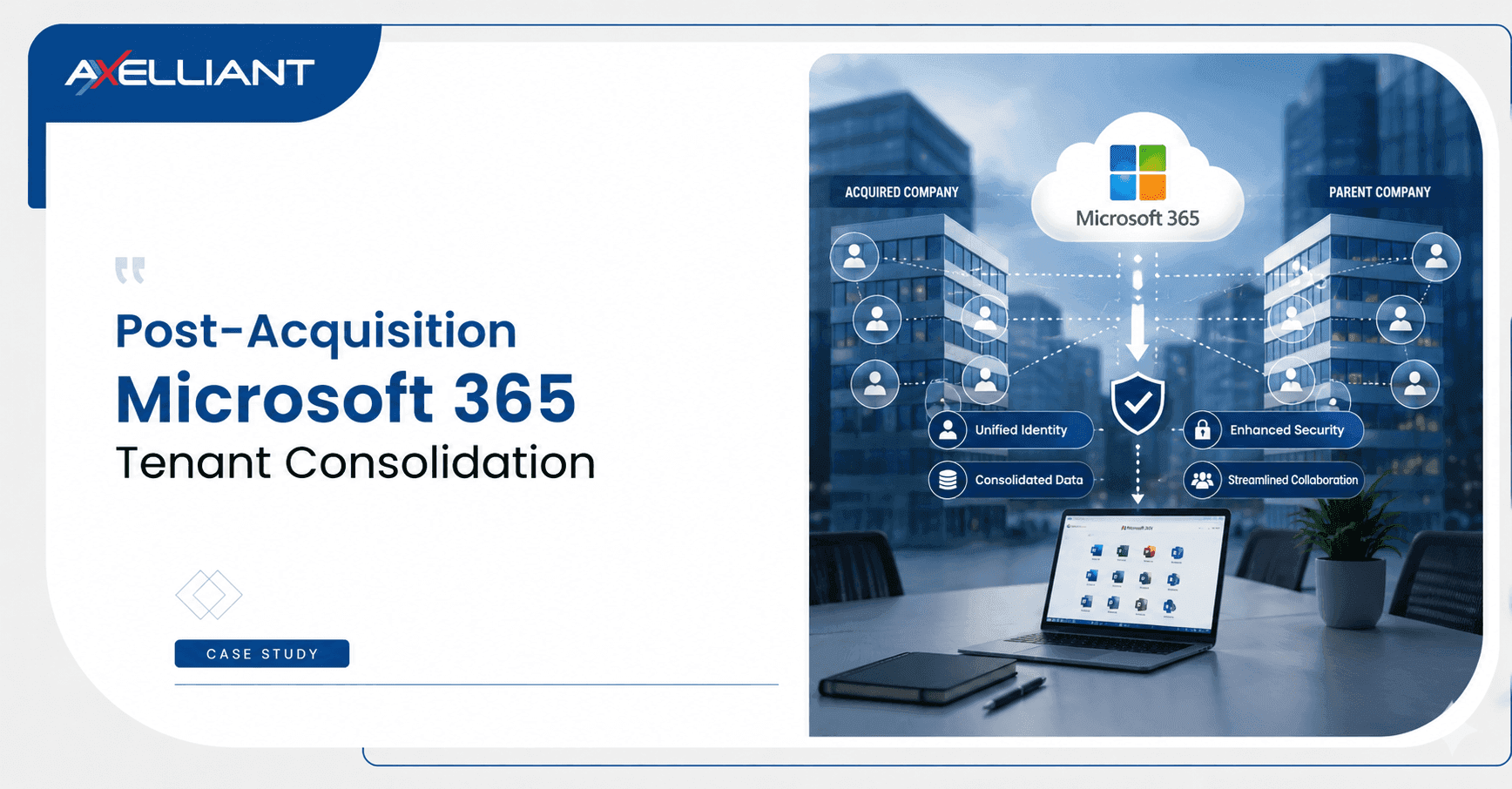
Case Study: Post-Acquisition Microsoft 365 Tenant Consolidation
Executive Summary
Following the strategic acquisition of Taycor Financial, North Mill Equipment Finance (NMEF) required a complete logical and structural consolidation of its cloud infrastructure. To unify operations, eliminate redundant software licensing overhead, and establish strict data governance, NMEF initiated an enterprise-scale Microsoft 365 (M365) tenant-to-tenant migration.
Axelliant was selected to design and execute the infrastructure consolidation, transferring all core user assets—including production mailboxes, multi-tier SharePoint architectures, Teams channel environments, and historical chat databases—into NMEF’s primary tenant without operational downtime or data degradation.
Organizational Profiles
North Mill Equipment Finance (NMEF)
Operating since 1957, NMEF provides small to mid-ticket equipment financing, commercial loans, and asset agreements for the transportation, construction, and manufacturing sectors across the United States.
- Domain: nmef.com
Taycor Financial
Established in 1997, Taycor Financial operates as a licensed commercial lender specializing in equipment leasing, working capital loans, and structured business lines of credit for small and medium enterprises.
- Domain: taycor.com
Architectural Scope and Objectives
The central objective was the complete decommissioning of the source tenant and the systematic migration of all assets into the target environment. The technical boundary encompassed:
- Identity and Exchange Ledger Migration: Transfer of all active user mailboxes along with deep-tier historical archive mailboxes, preserving exact folder hierarchies and retention tags.
- SharePoint Object Mapping: Migration of multi-site SharePoint collections, associated document libraries, document metadata, and site permissions.
- Collaborative Fabric Alignment: Migration of Microsoft Teams structural sites, public and private channels, and historical peer-to-peer chat logs.
Technical Migration Challenges
1. High Data Volume Density
The substantial size of the legacy exchange databases and multi-terabyte archive storage required an optimized throughput strategy to prevent throttling by Microsoft API boundaries and ensure execution within tight maintenance windows.
2. Complex SharePoint Permission Trees
Taycor’s SharePoint environment contained intricate, broken inheritance permission structures and customized access control lists (ACLs). Improper mapping risked exposing sensitive financial and lending records post-migration.
3. Non-Native Teams Chat Schema
Migrating historical Teams chat data and persistent channel conversations presents a well-known technical gap, as native Microsoft administration tools do not support the automated extraction and injection of conversational database logs across distinct tenants.
Solutions Architecture & Methodology
To overcome the limitations of native tooling and enforce absolute data integrity, Axelliant deployed a specialized technical framework:
[Discovery & Assessment] ➔ [Pilot Pipeline Testing] ➔ [Delta Sync Execution] ➔ [Final Cutover & Verification]
- Advanced API Brokerage: Axelliant deployed a specialized, enterprise-grade third-party migration engine configured to bypass standard tenant limits via parallel processing threads.
- Phased Delta-Sync Strategy: Execution followed a precise, multi-stage sync schedule. Seed data was migrated in the background while users remained active, leaving only low-volume delta changes for the final cutover window, reducing business disruption to zero.
- Automated Permission Remapping: A programmatic mapping matrix translated legacy source identities to target Azure Active Directory (now Microsoft Entra ID) objects, preserving security boundaries automatically.
Structural Implementation Steps
1. Discovery and Assessment
Axelliant engineers ran detailed PowerShell discovery scripts across the source tenant to catalogue every mailbox size, SharePoint URL, and Teams team GUID, identifying and isolating corrupted objects prior to extraction.
2. Pipeline Configuration and Hardening
The migration engine was deployed with custom application permissions within both Azure tenants, establishing secure, encrypted data tunnels to ensure compliance with financial data privacy rules.
3. Pilot Phase Validation
A production-representative cohort of accounts, data-heavy SharePoint sites, and complex Teams channels was migrated first. This allowed engineers to benchmark real-world transfer speeds, test metadata preservation, and refine the execution playbook.
4. Full-Scale Scheduled Cutover
The migration was executed in logical waves during non-operational hours. Engineers monitored transfer logs in real time, handling transient API errors instantaneously to prevent data loss.
5. Final Delta Sync and Handover
Following the MX record switch, final delta syncs captured any emails or chats generated during the cutover window. Post-migration scripts verified object counts before provisioning accounts for desktop access.
Measurable Infrastructure Outcomes
- Complete Data Preservation: All Exchange mailboxes and deep archives were transferred with zero data loss. Communication records remained accurate, chronologically sound, and intact.
- Unbroken Security Governance: SharePoint architectures and Microsoft Teams environments were mapped precisely to the target environment. File access rights, administrative groups, and directory rules remained intact, preventing data leaks or compliance gaps.
- Consolidating IT Overhead: The decommissioning of the legacy tenant successfully eliminated duplicate subscription renewals, reduced identity management overhead, and established a unified compliance perimeter across the entire merged enterprise.
Conclusion: Engineering Transition Precision
The seamless consolidation of Taycor Financial’s M365 environment into NMEF’s cloud core demonstrates the necessity of disciplined engineering design and rigorous data verification. By bypassing native tool limitations and systematically executing a phased, delta-driven migration plan, Axelliant eliminated the operational risks of corporate consolidation—ensuring that day-one of the merged entity was fully functional, compliant, and structurally secure.