
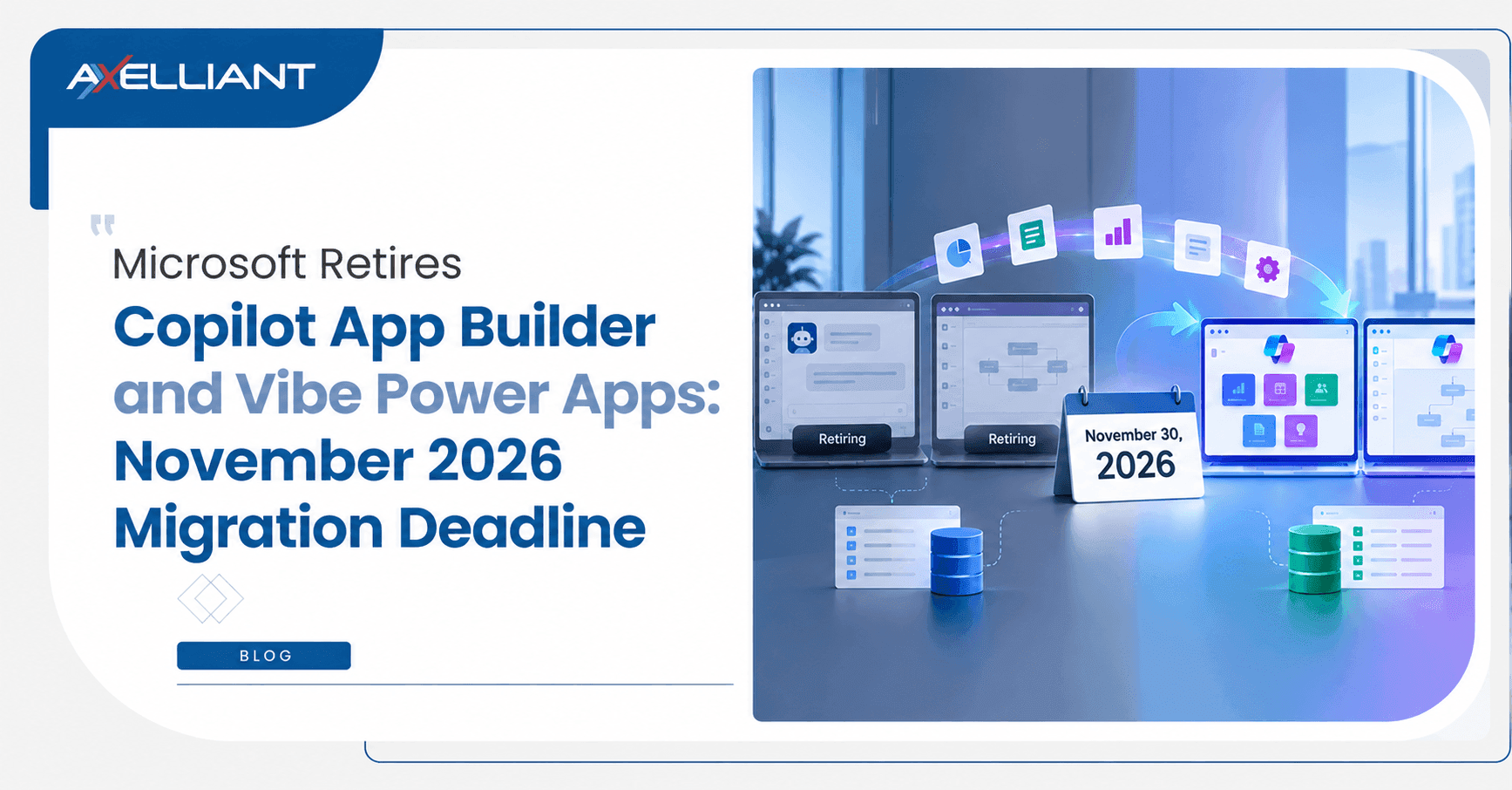
Microsoft Retires Copilot App Builder and Vibe Power Apps: November 2026 Migration Deadline
Microsoft is retiring two of its conversational AI app-building tools less than a year after bringing them to market. Both the App Builder agent inside Microsoft 365 Copilot and the lightweight vibe.powerapps.com environment are scheduled for full decommission on November 30, 2026. In their place, Microsoft is consolidating natural-language application authoring into Copilot Cowork and Microsoft Copilot Studio.
The transition is outlined in Microsoft Message Center advisory MC1505609, published on October 12, 2026. According to the timeline, new application creation across both retired platforms cuts off in mid-October 2026, leaving administrators and makers roughly six weeks to audit their tenants and transfer active assets before access terminates.
Clarifying What Is and Isn't Leaving
Headlines surrounding the update have created some confusion among business teams, but the actual blast radius is tightly contained. Microsoft is targeting only the chat-driven App Builder agent in Microsoft 365 Copilot and the experimental vibe.powerapps.com canvas introduced at Ignite in November 2025.
Standard Power Apps workflows remain completely untouched. Traditional canvas apps, model-driven architectures, Dataverse environments, and the broader Power Platform ecosystem are not part of this notice. Similarly, this retirement does not affect the standalone "agent builder" functionality found within canvas apps, which allows developers to build Copilot agents from existing app metadata.
Microsoft's core rationale centers on portfolio consolidation: unifying natural-language development under dedicated Copilot products gives makers a coherent authoring standard rather than scattering conversational tools across separate web properties. For enterprise IT leaders trying to prevent shadow IT and streamline maker activity, having structured governance backed by Power Platform solutions ensures these sudden roadmap pivots don't compromise core operational workflows.
The Next Destination: Copilot Cowork and Copilot Studio
For makers transitioning their workflows, Microsoft has pointed to two primary destinations introduced in early September. Inside Copilot Cowork, users can trigger app generation via the /app skill (currently available through the Microsoft Copilot Frontier Program). Alternatively, Microsoft Copilot Studio now provides a dedicated "App (Preview)" entry point directly on its home screen. In both tools, makers outline the desired business outcomes, target user groups, underlying data sources, and required actions, allowing agentic coding routines to generate an editable, inspectable application scaffold.
A significant shift in this generation of apps is the introduction of Copilot Managed Runtime. This preview infrastructure acts as the underlying host, automatically binding apps to Microsoft Entra identity, enforcing organizational data loss prevention (DLP) rules, handling Git-backed versioning, and centralizing administrative inventory under the Microsoft 365 admin center. End users will discover and launch these applications through a single managed hub at managedapps.cloud.microsoft.
Because licensing is also shifting—moving away from a flat Microsoft 365 Copilot seat requirement toward metered Copilot Credits for app authoring and runtime executions—organizations should closely monitor consumption. Working directly with an authorized Microsoft CSP Direct Partner helps enterprise procurement and finance teams navigate these metered credit models, optimize licensing allocations, and prevent unexpected overages.
Managing Platform Maturity and Governance Risks
While the consolidation makes long-term architectural sense, it creates an immediate practical challenge: administrators are essentially being asked to migrate from retired preview utilities into brand-new preview tools. Copilot Managed Runtime remains in public preview, and the Cowork authoring path still requires tenant enrollment in the Frontier program.
To safeguard business continuity, teams must pair this transition with deep visibility. Connecting maker metrics and app adoption directly to unified Microsoft Power BI services gives stakeholders clear oversight on which low-code apps are actively driving value versus those that can be safely retired before December 1.
Ultimately, building durable AI-assisted applications requires a hardened cloud environment. Aligning tenant identity boundaries, role-based access controls, and data protection through enterprise Azure cloud services ensures that as Microsoft's Copilot runtime matures, your data estate and custom applications remain stable, compliant, and production-ready.
Community Comments & Discussion
Elena Gomez (Cloud Infrastructure & Power Platform Lead)
"Having Git-backed source control and Entra identity out-of-the-box in Copilot Managed Runtime is a massive win for IT governance. Vibe coding was fun for rapid prototyping, but it was quickly becoming a shadow-IT nightmare. Centralizing inventory in the M365 admin center under managedapps.cloud.microsoft gives administrators the visibility we've been asking for since day one."
Marcus Chen (Digital Transformation Consultant)
"Don't wait for your makers to self-report. Most non-technical users who built an app on vibe.powerapps.com don't read Message Center alerts. The best move right now is running an inventory audit across your tenant, locating the associated SharePoint lists where that data lives, and separating the critical day-to-day tools from the one-off experiments before the November 30 cutoff."




David R. (Enterprise Architect, FinTech)