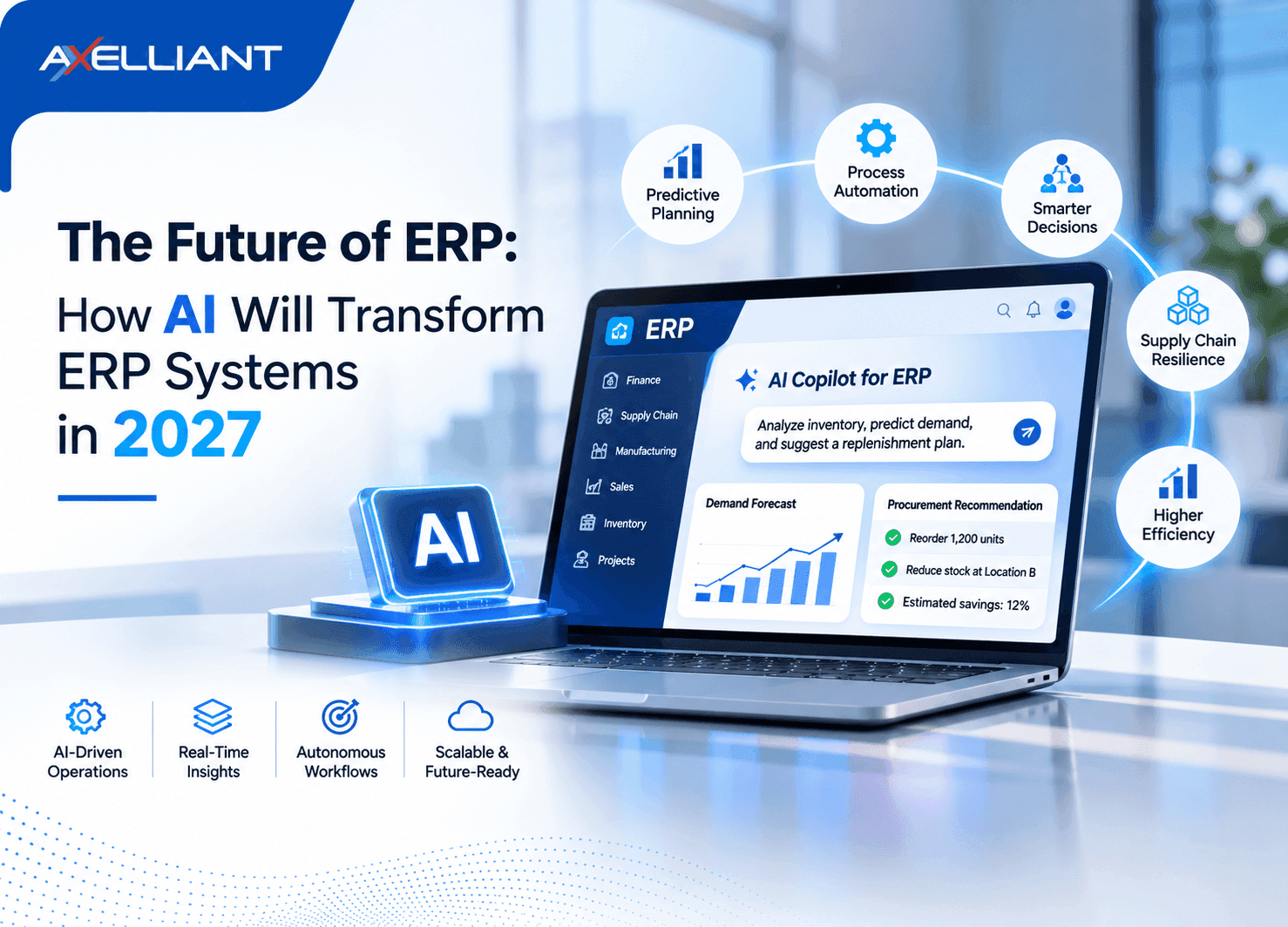
For 30 years, ERP has been a system of record. It stored what happened: the invoice posted, the stock moved, the order shipped. People did the thinking and the ERP kept the books.
By 2027, that starts to change. ERP is becoming a system of action, one that spots problems, suggests the fix and, more and more, carries it out. If your business runs on Microsoft Dynamics 365, this shift is already showing up in your release notes.
Here is what the next generation of ERP will look like, and what it means for your business.
Why 2027 Is a Turning Point for ERP
The numbers from Gartner explain why the timing matters. In August 2025, Gartner predicted that 40% of enterprise applications will include task-specific AI agents by the end of 2026, up from less than 5% the year before. Its roadmap points to 2027 as the year agents start working together, with different agents handling different parts of a single process.
Looking further out, Gartner expects 33% of enterprise software to include agentic AI by 2028, and at least 15% of day-to-day work decisions to be made autonomously.
In plain terms: the ERP you buy or upgrade over the next 12 months will look very different from the one you have today.
1. From Copilots to AI Agents
The first wave of AI in ERP was the copilot, an assistant you ask questions. “Summarize this vendor’s payment history.” “Draft a collections email.” Useful, but it waits for you.
The next wave is the AI agent. An agent is given a goal and a set of rules, then works through the steps on its own, handing off to a person only when it needs approval.
Microsoft has moved Dynamics 365 firmly in this direction. Its 2026 release waves add agents across sales, service, supply chain and finance: agents that coordinate demand planning and inventory rebalancing, support warehouse picking and routing, and run continuous financial reconciliation for a faster close.
What it means for you: The question changes from “How do my people use the ERP?” to “Which tasks should an agent own, and where does a person stay in the loop?”
2. Continuous Close Replaces Month-End Crunch
Month-end close is one of the most manual jobs in finance. Teams chase reconciliations, explain variances and fix posting errors under deadline pressure.
In the next-gen ERP, reconciliation runs every day, not once a month. AI matches transactions, flags exceptions and writes a first draft of the variance explanation. Microsoft lists automated reconciliations and variance explanations as core AI themes for Dynamics 365 Finance in 2026.
What it means for you: Finance teams spend less time assembling numbers and more time explaining them to the business.
3. Predictive, Self-Adjusting Supply Chains
Supply chains have relied on last year’s data to plan next quarter. That works until a port closes, a supplier misses a date or demand spikes.
AI-driven ERP blends live signals (orders, prices, supplier performance, lead times) to predict problems before they land. Dynamics 365 Supply Chain Management is adding predictive demand and supply-risk insights, along with features like price and demand correlation in demand planning.
What it means for you: Fewer stockouts, less excess inventory, and planners who manage exceptions instead of spreadsheets.
4. Conversation Becomes the Main Interface
Gartner expects that by 2028, a third of user experiences will move from native app screens to agentic front ends. For ERP, that means fewer menus and forms, and more asking.
A sales manager might ask in Microsoft Teams, “Which orders over $50,000 are at risk of shipping late this week?” and get an answer with recommended actions, without opening the ERP at all.
What it means for you: ERP becomes usable by far more people in your company, not just trained power users.
5. Role-Based Workspaces That Surface What Matters
Instead of a home page full of tiles, next-gen ERP gives each person a workspace that shows the tasks, risks and insights relevant to their role right now. Microsoft’s “immersive home” in Dynamics 365 is an early example: AI decides what you should look at first.
6. Data Becomes the Real Competitive Edge
Every one of these trends depends on clean, connected data. An agent that reconciles accounts is only as good as the chart of accounts and transaction data it reads. A demand forecast is only as good as the sales history behind it.
This is why platforms like Microsoft Fabric and Dataverse matter so much in the Dynamics 365 world. They connect ERP data with CRM, operations and external sources so AI has the full picture.
7. Governance Moves from IT Checklist to Board Topic
When software makes decisions, someone has to answer for them. Gartner warns that over 40% of agentic AI projects will be cancelled by the end of 2027 because of rising costs, unclear business value or weak risk controls.
The winners will set clear rules early: what agents can approve on their own, what needs a human sign-off, and how every AI action is logged and audited.
What Should Business Leaders Do Now?
You don’t need to rebuild everything for 2027. You need to be ready for it. Start here:
- Get to the cloud: Most new AI features in Dynamics 365 ship only to cloud deployments. If you’re still on Dynamics AX or an on-premises version, AI is a strong reason to plan your move.
- Fix your data: Clean master data (customers, vendors, items, chart of accounts) is the foundation for every AI use case.
- Pick one or two high-value processes: Reconciliation, collections and demand planning are proven starting points.
- Set AI governance rules: Decide approval limits, audit trails and data access before you switch agents on.
- Train your people: The teams who learn to manage AI agents will move fastest.
The Bottom Line
The next generation of ERP won’t just record your business. It will help run it. Companies that prepare their data, processes and people now will be the ones that get real value from AI in 2027, while others are still running pilots.
Ready to see what AI can do in your Dynamics 365 environment? Axelliant helps businesses plan, implement and optimize Microsoft Dynamics 365 with AI built in. Talk to our team to map your path to an AI-ready ERP.
Next in this series: How to Prepare Your ERP for AI: A Readiness Checklist for Dynamics 365.